Konkrete Ausgangslage
Der Use Case lohnt sich, wenn wiederkehrende Aufgaben heute manuell geprüft, kopiert, beantwortet oder zwischen Systemen weitergereicht werden.
 ConsultingServices.aiAI Consulting for SMEs
Use Case in Detail
Green IT merges with hard finance metrics. Machine learning autonomously regulates the energy consumption of server infrastructures and industrial networks without violating SLAs. Less carbon footprint, more regulatory compliance (CSRD).
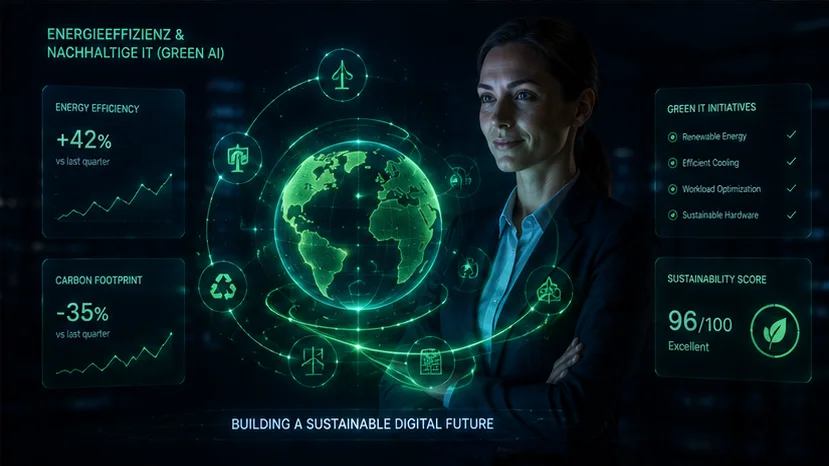
An AI Control Plane connects to network nodes and cloud resources. It predicts the load for the next 6 hours and adaptively shuts down clusters or facility areas. For ESG compliance, automated real-time carbon reporting dashboards run in parallel.
Less suitable if: Combined with pure legacy hardware operation, where no digitally controllable relay exists.
Business Impact
in network idle time through proactive downscaling.
Automated provision of emission data for EU regulations.
No interruptions, pure avoidance of unused overprovisioning.
Based on hundreds of weather, seasonal, and operational parameters, the ML model predicts load peaks for the next shift.
Completely autonomous scaling (shutting down cooling, turning off unnecessary racks).
Simultaneously, data records are written to an immutable ledger and delivered as a report to finance/sustainability officers at the end of the month.
Frequently Asked Questions
The system always operates within conservatively set guardrails (safety bounds). For example, if the algorithm expects 10% load, it dims the system to 15% – never to 10%. There is a buffer for microbursts.
Due to the CSRD (Corporate Sustainability Reporting Directive), CFOs are under pressure. Automated CO2 data tracking is now a massive cost advantage compared to auditor invoices.
Make energy demands transparent. We will show you how to reduce KPIs and automate reporting.
Vertiefung
Damit ein Use Case nicht nur interessant klingt, muss er in Prozessvolumen, Datenlage, Risiko und messbarer Wirkung übersetzt werden.
Der Use Case lohnt sich, wenn wiederkehrende Aufgaben heute manuell geprüft, kopiert, beantwortet oder zwischen Systemen weitergereicht werden.
Der wirtschaftliche Hebel entsteht meist aus eingesparter Bearbeitungszeit, weniger Fehlern, schnellerer Reaktionszeit und besserer Auslastung vorhandener Teams.
ROI-Beispiel
Das entspricht rund 24.000 EUR manuellem Jahresaufwand. Bei 30 Prozent Entlastung entsteht ein rechnerisches Potenzial von ca. 7.200 EUR pro Jahr.
Die tatsächliche Wirtschaftlichkeit hängt von Prozessvolumen, Datenqualität, Integrationsaufwand und Freigabeanforderungen ab.