Konkrete Ausgangslage
Typisch sind Teams, die täglich dieselben Status-, Termin-, Produkt- oder Servicefragen beantworten und dadurch kaum Zeit für komplexe Anliegen haben.
 ConsultingServices.aiAI Consulting for SMEs
Use Case in Detail
High call center volume, 80% repeat inquiries, and overload during peak times lead to frustration for both customers and your team. A multilingual virtual assistant (voice & chat) handles first-level inquiries 24/7 and integrates seamlessly into your existing systems.
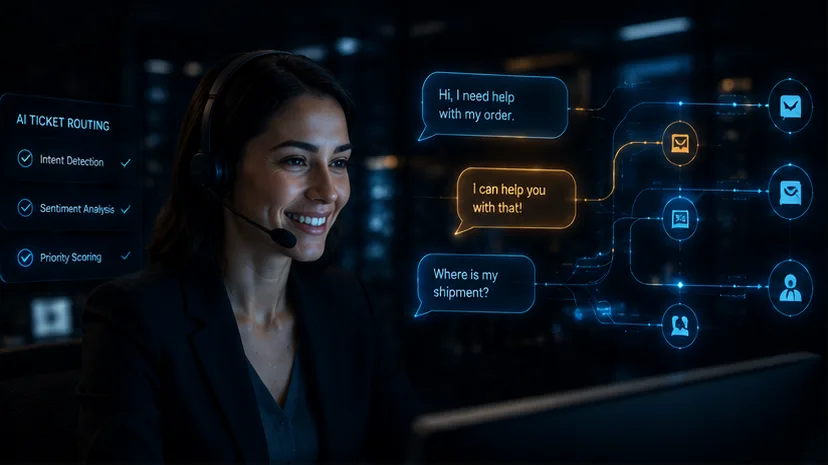
An omnichannel AI assistant (web, WhatsApp, voice) captures first-level tickets, verifies identities, and accesses the backend via API to provide personalized responses (e.g., delivery status) in over 50 languages.
Less suitable if: You provide highly exclusive B2B support for very few accounts, where personal connection makes up 100% of the value.
Business Impact
Routine questions do not reach human agents at all (Deflection Rate).
Answers for customers in over 50 languages – without night shifts.
Cost savings with external service providers and call centers immediately offset the project costs.
The Solution in Practice
It doesn't matter which channel the customer inquires through. The process is always harmonized.
The virtual assistant is available as a web chat, a channel in the messaging service (WhatsApp), or as a voice agent in the phone system.
The language model recognizes the true intent behind the question, even with spelling mistakes or vague phrasing.
If the solution requires, for example, an order status, the AI queries this in the background (e.g., via Zendesk/Salesforce/Shopify API). If the bot does not know how to proceed, it escalates with context to a human agent.
Frequently Asked Questions
Poorly programmed "click-tree bots" scare off customers (Press 1 for...). Modern agents interact fluently, empathetically, and if in doubt, they transfer the conversation to a human within seconds. The customer will have their problem solved extremely quickly – and that makes them happy.
The bot operates not in "creative" but in RAG mode. We can strictly prohibit it from "making up" answers. If it does not know the information reliably from a validated system document, it always (!) transfers to a human agent. Compliance and brand image are safe.
Do you have specific systems and complex data silos? Let's talk about secure integrations.
Vertiefung
Damit ein Use Case nicht nur interessant klingt, muss er in Prozessvolumen, Datenlage, Risiko und messbarer Wirkung übersetzt werden.
Typisch sind Teams, die täglich dieselben Status-, Termin-, Produkt- oder Servicefragen beantworten und dadurch kaum Zeit für komplexe Anliegen haben.
Eine realistische Rechnung startet mit Ticketvolumen, durchschnittlicher Bearbeitungszeit und Deflection-Rate. Wenn 30 Prozent der Standardanfragen sicher automatisiert werden, entsteht schnell ein spürbarer Zeit- und Servicehebel.
ROI-Beispiel
Der manuelle Aufwand liegt rechnerisch bei ca. 108.000 EUR pro Jahr. Bei 35 Prozent Entlastung ergibt sich ein Potenzial von ca. 37.800 EUR pro Jahr.
Gezählt werden nur wiederkehrende Standardfälle. Komplexe Reklamationen, Eskalationen und sensible Fälle bleiben beim Team.