Konkrete Ausgangslage
Der Use Case lohnt sich, wenn wiederkehrende Aufgaben heute manuell geprüft, kopiert, beantwortet oder zwischen Systemen weitergereicht werden.
 ConsultingServices.aiAI Consulting for SMEs
Use Case in Detail
Long release cycles (avg. 6-8 weeks), high manual effort in code reviews, and error-prone change management hinder your innovation power. AI developer copilots and smart release safeguards reduce overhead, accelerate time-to-market, and lower the risk of failures in production.
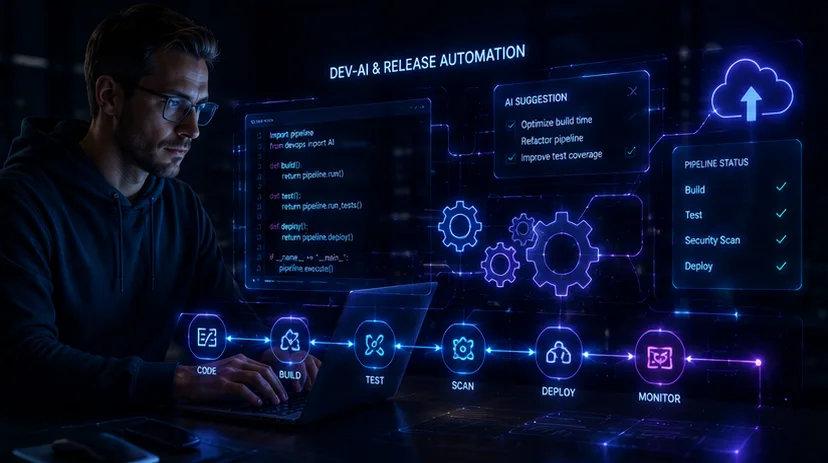
An enterprise LLM (like GitHub Copilot or custom corporate LLMs) supports coding integrated into the IDE. In the CI/CD pipeline, an AI takes over pull request analysis, uncovers IT security gaps, and assesses the risk of failure (Impact Analysis) fully automated based on telemetry and incident data before going live.
Less suitable if: You work without version control (Git) or without structured CI/CD pipelines, or your codebase consists entirely of extremely proprietary niche languages without LLM reference.
Business Impact
Automation of boilerplate and testing accelerates the entire application lifecycle.
Repetitive tasks are drastically reduced, significantly shortening the onboarding of new senior developers.
AI-supported risk analysis catches faulty architectures in the pull request stage (Shift-Left).
The Solution in Practice
AI supports both operational development (Inner Loop) and strategic governance (Outer Loop).
Developers receive direct suggestions and AI support while writing code (e.g., code completion, refactoring legacy functions, and automatic in-line documentation).
An AI bot automatically checks the branch immediately after the push for company architecture guidelines, security flaws (OWASP), and test coverage – long before a senior developer makes the final approval.
Data models evaluate historical releases, tickets, and code churn to dynamically calculate the risk of an upcoming deployment (Low/Medium/High Risk). The CAB focuses only on high-risk issues.
Frequently Asked Questions
Modern corporate LLMs or enterprise copilot models (like via Microsoft Azure) contractually assure that your written source code remains strictly within your tenant and is not used for training global base models under any circumstances. For highly sensitive air-gapped infrastructures, we rely on secure, locally hosted on-premise open-source models if necessary.
On the contrary: The AI acts as a senior "pair programming partner," asking questions in context and explaining unknown legacy code in real-time for the onboarding of new colleagues. Architectural responsibility ("Human-in-the-loop") is not replaced but rather shifts the focus from copy & paste to real software design.
Do you have outdated pipelines and want to strategically and yet risk-free increase developer productivity? Let’s talk about secure architectures and compliance in the coding process.
Vertiefung
Damit ein Use Case nicht nur interessant klingt, muss er in Prozessvolumen, Datenlage, Risiko und messbarer Wirkung übersetzt werden.
Der Use Case lohnt sich, wenn wiederkehrende Aufgaben heute manuell geprüft, kopiert, beantwortet oder zwischen Systemen weitergereicht werden.
Der wirtschaftliche Hebel entsteht meist aus eingesparter Bearbeitungszeit, weniger Fehlern, schnellerer Reaktionszeit und besserer Auslastung vorhandener Teams.
ROI-Beispiel
Das entspricht rund 24.000 EUR manuellem Jahresaufwand. Bei 30 Prozent Entlastung entsteht ein rechnerisches Potenzial von ca. 7.200 EUR pro Jahr.
Die tatsächliche Wirtschaftlichkeit hängt von Prozessvolumen, Datenqualität, Integrationsaufwand und Freigabeanforderungen ab.