Konkrete Ausgangslage
Der Use Case lohnt sich, wenn wiederkehrende Aufgaben heute manuell geprüft, kopiert, beantwortet oder zwischen Systemen weitergereicht werden.
 ConsultingServices.aiAI Consulting for SMEs
Use Case in Detail
Historically grown IT landscapes and isolated data silos block sustainable innovations. A modern Lakehouse architecture breaks down these silos, consolidates your data structures, and creates a highly performant "single source of truth" that paves the way for advanced analytics and generative AI.
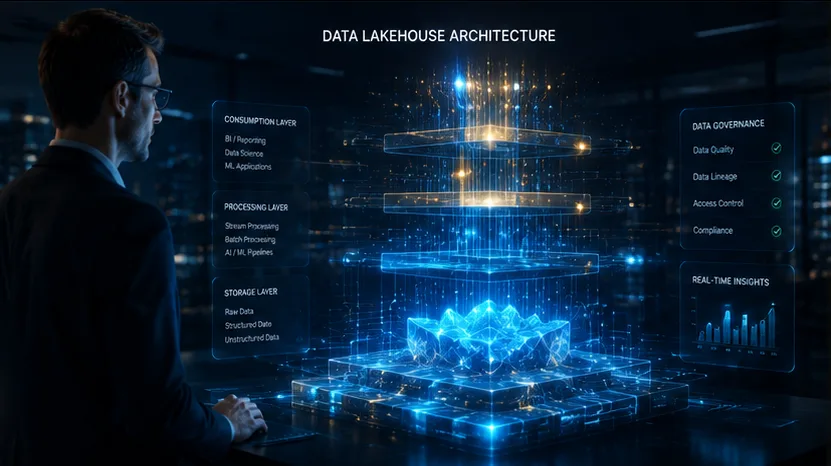
Implementation of a data lakehouse architecture (e.g., based on Databricks or Microsoft Fabric). Unstructured, semi-structured, and structured data converge centrally and scalably. AI-driven governance rules ensure fully automated cleansing and master data management.
Less suitable if: Your company derives its value creation entirely from a homogeneous standard ERP (e.g., 100% OOTB SAP) without significant cross-analysis needs.
Business Impact
Complete data availability establishes the foundation for future-proof AI initiatives.
Automated pipelines drastically minimize efforts in data cleansing and mapping.
Unified customer, product, or supplier view without blind spots from silos.
The Solution in Practice
How AI seamlessly and securely integrates into your business processes.
Real-time and batch ingestion of various raw data (log files, ERP, CRM) into a highly scalable, cost-effective data lake.
Data is validated, normalized, and converted into standardized schemas (e.g., Delta Tables). AI services assist with automatic schema mapping.
Provision of highly aggregated data models for BI dashboards, machine learning workflows, and external APIs.
Frequently Asked Questions
Lakehouses have significantly lowered the barriers to data utilization. Low-code tools and AI assistants (like co-pilots in Databricks or Fabric) enable data analysts today to perform tasks that were previously reserved for hardcore engineers.
No. A data warehouse forces you to pre-press all data into rigid structures, excluding unstructured data (images, documents for AI). A lakehouse combines the flexibility of a data lake with the management capabilities of a warehouse.
Are you sitting on untapped data treasures or are AI pilots failing due to data quality? Let's discuss a future-proof architectural pattern.
Vertiefung
Damit ein Use Case nicht nur interessant klingt, muss er in Prozessvolumen, Datenlage, Risiko und messbarer Wirkung übersetzt werden.
Der Use Case lohnt sich, wenn wiederkehrende Aufgaben heute manuell geprüft, kopiert, beantwortet oder zwischen Systemen weitergereicht werden.
Der wirtschaftliche Hebel entsteht meist aus eingesparter Bearbeitungszeit, weniger Fehlern, schnellerer Reaktionszeit und besserer Auslastung vorhandener Teams.
ROI-Beispiel
Das entspricht rund 24.000 EUR manuellem Jahresaufwand. Bei 30 Prozent Entlastung entsteht ein rechnerisches Potenzial von ca. 7.200 EUR pro Jahr.
Die tatsächliche Wirtschaftlichkeit hängt von Prozessvolumen, Datenqualität, Integrationsaufwand und Freigabeanforderungen ab.